
Buying a forex brokerage can mean buying the regulated company (a share deal), buying selected assets, or taking over only a client book, and each route transfers very different things. Before you buy, confirm which entity, licence, clients, bank accounts and provider contracts you will own on day one, and which regulator must approve the change.
FXCM’s 2026 break-up shows all three routes in practice. If you are already comparing a specific forex brokerage for sale, the lessons below help you read the seller’s offer correctly.
Last reviewed: 25 November 2026
What happened to FXCM in 2026?
FXCM was sold in parts, not as one company. Its UK client book moved to Trade Nation, AvaTrade agreed to acquire the majority of the remaining FXCM business and brand, and FXCM Pro’s non-UK institutional clients were offered a move to JT Prime. Each part used a different deal structure.
FXCM, founded in New York in 1999, came under the control of Jefferies after the January 2015 Swiss franc event (The TRADE, 13 Oct 2026). Jefferies took full ownership on 14 September 2023 (FX News Group), and the group’s companies were renamed Stratos, with FXCM continuing as a brand (Finance Magnates, 11 Sep 2023).
Trade Nation: FXCM’s UK client book
- Agreed: 6 October 2026 (Trade Nation).
- What moved: the UK client book of Stratos Markets Limited (trading as FXCM UK), not the regulated entity.
- How: FXCM UK accounts and open positions were closed, and client details and funds moved to new Trade Nation accounts (FXCM UK). The transfer was scheduled for 20–22 November 2026 (FXCM UK), and Trade Nation’s page for FXCM UK clients says the move is complete (checked 25 Nov 2026, Trade Nation).
AvaTrade: most of the remaining FXCM business
- Announced: 9 October 2026 (Business Wire).
- What moved: “the majority of FXCM Group’s business” and the brand. A Jefferies SEC filing described the sale as covering the assets and operations of Stratos Group, with the acquired assets expected to migrate over about 120 days; terms were not disclosed (The TRADE, 13 Oct 2026). FXCM subsidiaries hold licences in Cyprus, Australia, South Africa, Israel and St. Vincent and the Grenadines (FX News Group, 9 Oct 2026).
- Status: AvaTrade’s page for FXCM clients says their account migration is complete (checked 25 Nov 2026, AvaTrade). We have not found a separate announcement that the transaction itself has closed.
JT Prime: FXCM Pro’s non-UK institutional clients
- Reported: 18 November 2026. FXCM Pro is to end non-UK services on 18 December 2026 and is offering these clients migration to JT Prime (Finance Magnates, 18 Nov 2026). JT Prime launched on 10 November 2026 (GlobeNewswire).
Finance Magnates described the AvaTrade agreement as the capstone of “a piecemeal carve-out of FXCM’s operations” (Finance Magnates, 9 Oct 2026).
What does “buying a forex brokerage” actually mean?
“Buying a forex brokerage” covers three different transactions. A share deal transfers the company with its licence, history and liabilities. An asset deal transfers selected operations, brands or contracts. A client-book transfer moves clients into the buyer’s own authorised entity. Know which one is on offer before you discuss terms.
| Structure | What you get | 2026 example |
|---|---|---|
| Share deal | The company, its licence, history and liabilities, subject to regulator approval of the new owner | CXM Group acquired TD Markets (Pty) Ltd, South Africa, effective 1 Oct 2026; brand, team and FSCA licence (FSP 49128) stay, and client accounts are unchanged (CXM, 16 Oct 2026; TD Markets FAQ) |
| Asset deal | Selected operations, brand, contracts and client relationships | AvaTrade–FXCM |
| Client-book transfer | Clients who agree to move to your existing authorised entity | Trade Nation–FXCM UK |

Five lessons for anyone buying a forex brokerage
The FXCM deals point to five practical lessons: confirm the deal structure, remember that licences stay with the entity, plan for client retention, map every entity in the group, and check every provider contract for change-of-ownership terms. Each one changes what you are really paying for.
1. Confirm the structure first
The same headline, “broker acquired”, described a client-book transfer, an asset deal and a share deal within a few weeks of each other. Ask the seller in writing which one is on offer.
2. A licence stays with the entity
In a client-book or asset deal, the buyer needs its own authorisation in that market; the seller’s licence stays behind. In a share deal, the licence stays with the company, and the new owner usually needs the regulator’s prior approval. A listing worded as a “forex broker license for sale” is in practice the sale of a company that holds the licence.
3. Clients and positions may not move as they are
FXCM told its UK clients that open positions would be closed on the transfer date and new accounts opened at the buyer (FXCM UK). When you value a client book, model retention conservatively.
4. Map the whole group, not just the regulated company
TD Markets’ disclosures say that, for certain products, the South African company acts as an intermediary while client trades are entered into with TDM Holdings LLC in St. Vincent and the Grenadines as principal counterparty (TD Markets FAQ). Ask for the full group structure.
5. Check every provider contract
The FXCM Pro change shows that liquidity and institutional relationships are part of what you buy. Ask for every platform, liquidity, bank and payment contract, and confirm whether each continues after a change of ownership.
Is it better to buy a forex brokerage or build a new one?
Buying fits buyers who need a specific licence or market quickly and can fund deep due diligence. Building fits founders who want a clean structure designed around their model. Buying is faster only if the licence, banking and provider contracts genuinely continue after closing.
| Acquire an existing brokerage | Build a new one | |
|---|---|---|
| Speed to market | Faster if licence, banking and providers continue | Licence and bank onboarding set the pace |
| Regulatory step | Change-of-control approval; in the UK the FCA has up to 60 working days from a complete notification (FCA, checked 25 Nov 2026) | New authorisation application in the chosen jurisdiction |
| Capital | Purchase consideration plus the regulator’s ongoing capital requirement | The regulator’s capital requirement for the chosen licence (for example, DFSA base capital rules in PIB 3.6) |
| What to check closely | Past liabilities, complaints, client-money records | Application timeline and provider onboarding |
| Clients | May come with the business; retention varies | Start from zero |
If you decide to build, the usual starting points are a forex white label solution or a forex turnkey solution, with forex brokerage setup covering the full path and forming a company based on your needs in the right jurisdiction. Forming a company does not by itself grant a financial licence. Our White Label vs Full Brokerage vs Buying a Broker guide compares the routes in more depth.
What should a forex brokerage due-diligence checklist include?
A forex brokerage due-diligence checklist should confirm exactly what is for sale, the licence’s scope and standing, real client and revenue figures, liabilities and complaints, banking and payment continuity, platform and liquidity contracts, and the data-protection basis for moving client records. Treat every claim in the seller’s pack as unverified until you see evidence.
- What is for sale: entity names and numbers, ownership chart, exact shares or assets, and which liabilities stay or pass.
- Regulatory status: licence scope, conditions, permitted clients and markets, and open regulatory matters, checked on the regulator’s public register.
- Operations: active versus dormant clients, monthly revenue and costs, complaints, pending withdrawals and client-money records.
- Banking and payments: which accounts and payment providers continue after closing, and which need new onboarding.
- Technology: who holds the MetaTrader or other platform agreement, and what the vendor permits after a change of ownership (MetaQuotes, MT5 for brokers).
- Liquidity and other providers: every contract, whether it continues, and notice periods.
- Data protection: whether client records can be shared and transferred lawfully under the deal structure.
The full version is our forex brokerage acquisition due diligence checklist.
How does change-of-control approval work?
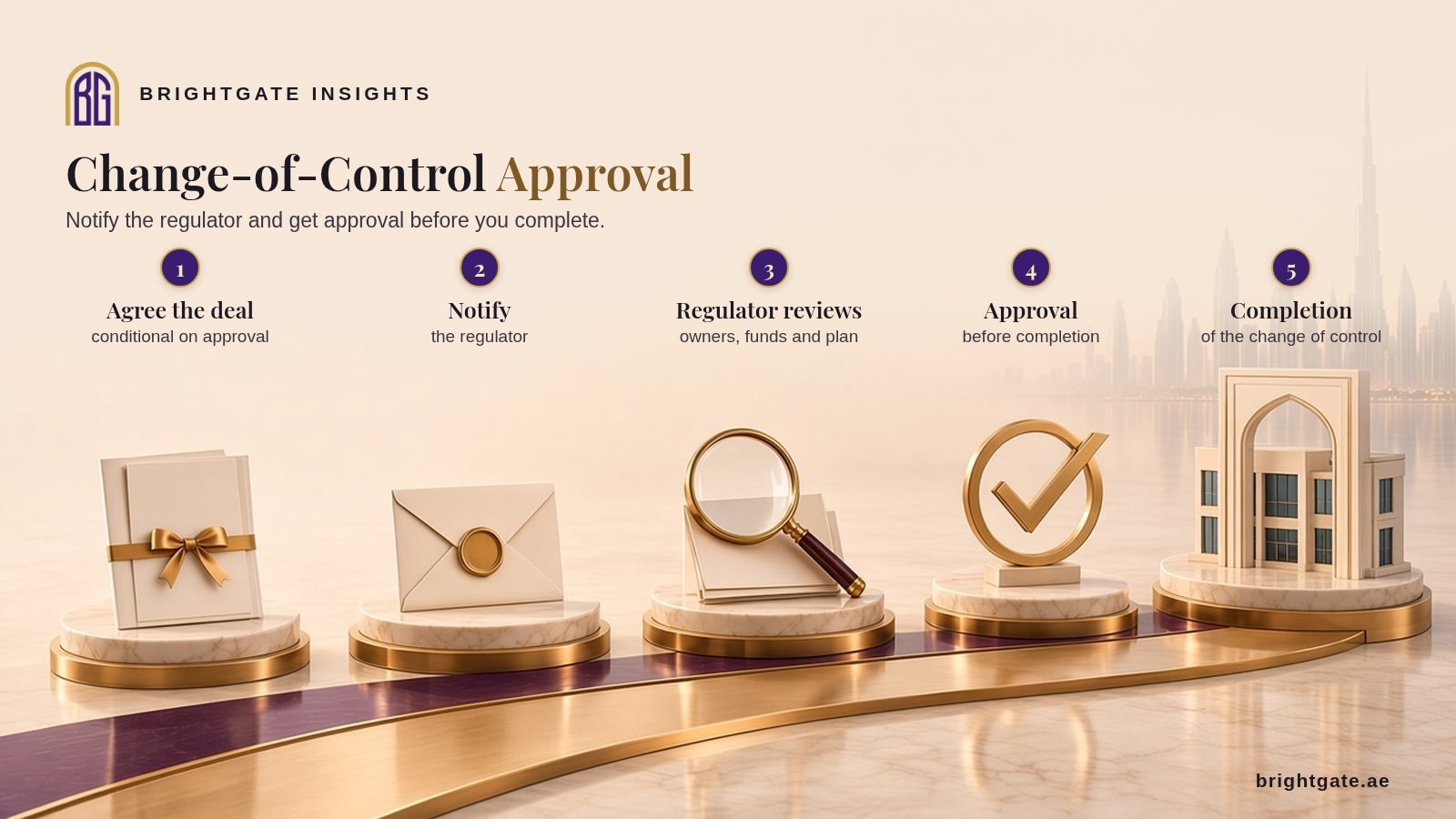
Most financial regulators require anyone who plans to acquire or increase control of an authorised firm to notify the regulator and obtain approval before completing. Expect the regulator to review the buyer’s ownership, source of funds, fitness and business plan, and build that review period into the deal timetable.
In the UK, the FCA says buyers must notify it and obtain approval before a change in control takes place, and that it has up to 60 working days from a complete notification, excluding any period when it asks for more information, to assess the case (FCA, Change in control, checked 25 Nov 2026). Other regulators, including the DFSA in the DIFC, the FSRA in ADGM, CySEC and the FSCA, set their own thresholds, forms and timelines. Make completion conditional on approval.
Where can you find a forex brokerage for sale?
Start with what is actually on offer and in which jurisdiction. Bright Gate’s page of forex brokerages for sale, organised by jurisdiction lists acquisition briefs, including the United Kingdom, South Africa and Cyprus. Each brief is a starting point to verify.
Availability, licence scope and transfer terms are confirmed independently for every transaction, and the structure (share deal, asset deal or client book) is set out before any discussion of terms.
How Bright Gate helps acquirers
Bright Gate is a Dubai-based advisory firm, not a broker, law firm or regulator. We help buyers define the target profile, review acquisition briefs, and coordinate independent legal, financial, regulatory and technical due diligence, along with the provider and banking workstreams.
Regulators decide change-of-control applications, and providers decide whether their contracts continue. Our role is to keep those workstreams organised so you can make the decision on evidence.
Frequently asked questions
What happened to FXCM in 2026?
FXCM’s owner, Jefferies-owned Stratos Group, sold the business in parts. Trade Nation agreed on 6 October to take over the UK client book, and the move is now complete. AvaTrade announced on 9 October an agreement to acquire the majority of the remaining business and brand; it says FXCM client migration is complete. FXCM Pro’s non-UK institutional clients were offered migration to JT Prime ahead of 18 December.
Is it faster to buy a forex brokerage than to start one?
It can be, if the licence, banking and provider contracts genuinely continue after closing. Change-of-control approval is still needed in most jurisdictions, and due diligence takes time.
What is the difference between buying a brokerage and buying a client book?
Buying the brokerage (a share deal) gives you the company and its licence, subject to regulatory approval. Buying a client book moves clients to your own authorised entity, usually by closing and reopening their accounts.
Does the licence transfer when I buy a forex brokerage?
In a share deal the licence stays with the company, and the regulator normally approves the new owner first. In an asset or client-book deal, the seller’s licence does not transfer to you.
How long does change-of-control approval take?
It depends on the regulator. In the UK, the FCA has up to 60 working days from a complete notification, excluding any period when it asks for more information.
Does Bright Gate sell brokerages?
Bright Gate publishes acquisition briefs and coordinates the advisory process with independent specialists. It does not grant licences or approvals, and every opportunity is verified independently.
Discuss an acquisition
Share your target markets, timeline and preferred deal structure, and we will outline what to verify first. Terms are discussed in the meeting, based on your needs.
This article is for general information. It is not legal, regulatory, accounting or investment advice. Bright Gate Group coordinates independent providers and is not a regulator.