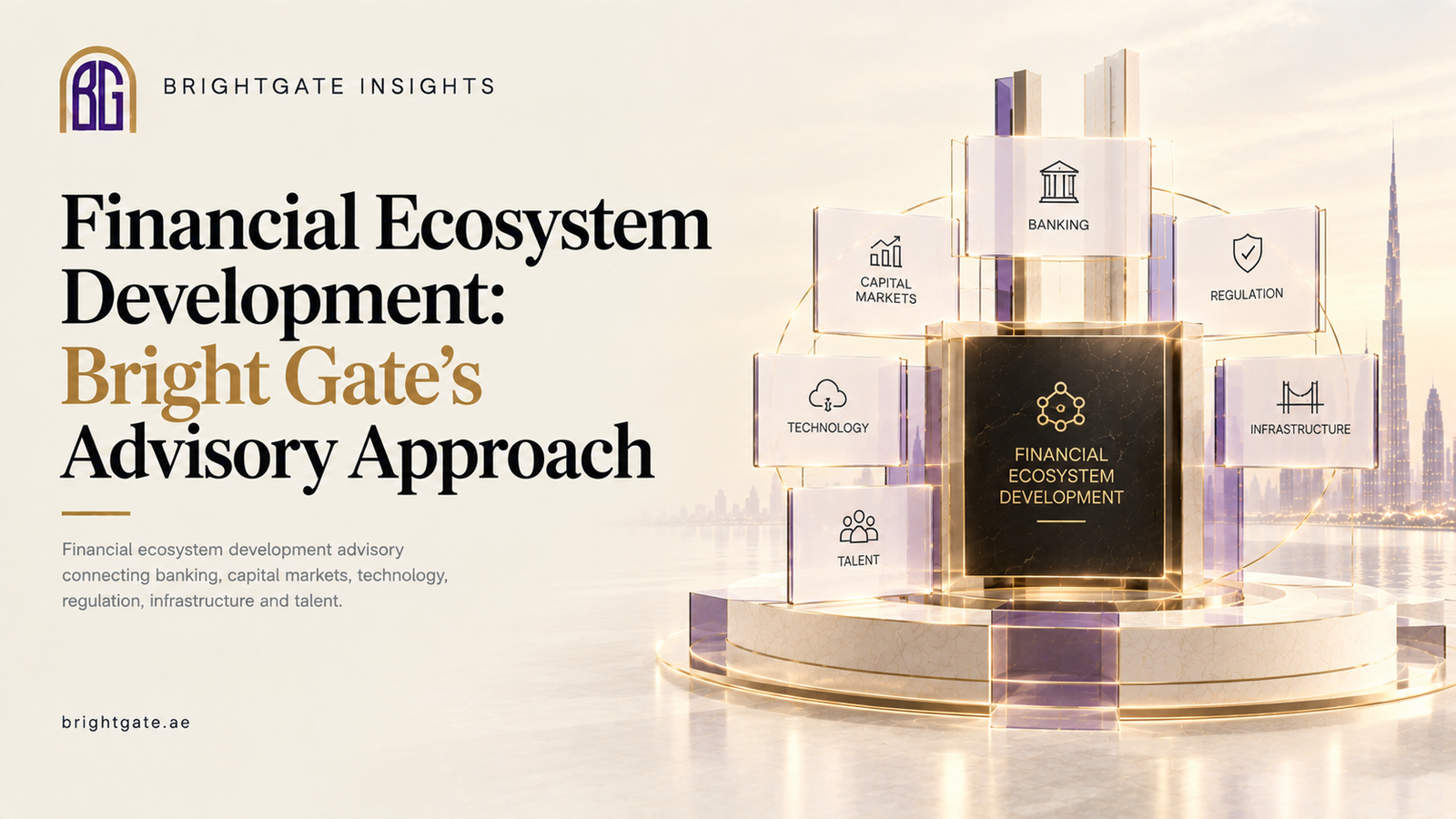
Financial centres do not develop simply because a jurisdiction introduces a new regulation, licence or financial product. Sustainable financial-sector growth requires a connected strategy bringing together regulation, institutions, market infrastructure, capital, technology, talent and commercial participation.
This is where financial ecosystem development advisory becomes relevant. Governments, economic development authorities, financial centres and private-sector stakeholders may need to assess how these components can support financial innovation, capital formation, investment activity and long-term economic development. The objective is not simply to attract businesses, but to create the conditions in which credible institutions and market participants can establish lasting activity
Bright Gate Group approaches financial ecosystem development through a strategic advisory framework that evaluates infrastructure, market requirements, stakeholder participation, and long-term implementation objectives. Rather than focusing on a single component, the advisory process considers how the wider financial environment can evolve as a connected system.
Understanding What Creates a Financial Ecosystem
A financial ecosystem consists of the institutions, infrastructure, regulatory frameworks, professional services and market participants that collectively support financial and economic activity. Depending on the jurisdiction, this may include regulators, commercial banks, payment providers, capital-market institutions, investment firms, technology companies, professional advisers and institutional investors.
The strength of an ecosystem depends less on the size of any single institution than on how effectively these participants interact. Financial ecosystem development therefore begins by identifying gaps, dependencies and the conditions required for participants to operate within a credible and commercially viable environment.
Bringing Public and Private Stakeholders Together
Stakeholder coordination is one of the most difficult aspects of financial ecosystem development. Regulators, government authorities, financial institutions, investors, technology providers and commercial businesses may have different responsibilities and priorities. A workable development strategy must recognise these differences while establishing clear areas of cooperation.
Isolated initiatives are rarely enough to build a successful financial centre. Financial institutions need credible market opportunities and infrastructure. Investors require regulatory clarity, suitable structures and access to opportunities. Technology providers need commercial demand and integration pathways, while businesses require efficient banking, payments and professional services.
Bright Gate Group assesses how these stakeholder groups interact and where stronger coordination may be required. The objective is to create a practical participation framework that supports long-term market development rather than a collection of disconnected short-term initiatives.
Technology Is Reshaping Modern Financial Ecosystems
Technology continues to reshape financial markets and the way institutions, businesses and customers interact. Digital payments, API-based services, fintech platforms and embedded-finance models can expand access to financial services and support new forms of commercial activity.
However, introducing technology without assessing market demand, institutional readiness, cybersecurity, regulation and operational capacity can create fragmented systems and unnecessary costs. At the same time, failing to evaluate relevant innovation may weaken a financial centre’s future competitiveness.
Technology should therefore be considered within the wider ecosystem strategy rather than treated as a standalone project. Bright Gate Group assesses technology requirements alongside financial infrastructure, participant needs, regulatory considerations and implementation priorities.
Infrastructure Should Follow Strategy
Financial infrastructure is often viewed as the starting point of ecosystem development, yet the strongest projects usually begin with strategy. Before new platforms, payment systems, or financial services are introduced, decision-makers need a clear understanding of market demand and long-term objectives. This includes assessing target sectors, identifying participant requirements, and evaluating how banks, investors, businesses, and service providers are expected to interact within the ecosystem.
Once these requirements are understood, infrastructure planning becomes more focused. The objective is not simply to introduce new systems but to create an environment that can support future growth and adapt as market activity evolves. Scalability, implementation priorities, and participant needs should therefore guide infrastructure decisions rather than the other way around. A strategic foundation helps ensure that development efforts contribute to a connected and sustainable financial environment.
Why Capital Formation Supports Ecosystem Growth
A financial ecosystem becomes more effective when it can mobilise savings and direct capital towards businesses, infrastructure and productive investment opportunities. Capital formation can support enterprise growth, market development and wider economic diversification. Institutional investors, venture-capital firms, asset managers, banks and private investors contribute to this process in different ways. Their participation can strengthen market depth, improve access to finance and support the development of emerging sectors.
A connected ecosystem should therefore create credible channels through which capital providers and suitable opportunities can interact. This may involve capital-market infrastructure, investment vehicles, professional services, regulatory frameworks and reliable information systems.
Financial Centres Need a Long-Term Competitive Position
Financial centres operate in an increasingly competitive global environment. Jurisdictions are often competing to attract financial institutions, investment activity, technology companies, and professional service providers. Success therefore depends on more than infrastructure alone. It requires a clear market position and a long-term development strategy.
A competitive financial centre should understand its strengths, identify the sectors it wants to attract, and create an environment that supports sustainable participation. This may involve attracting international institutions, encouraging investment activity, supporting economic diversification, and strengthening market connectivity. Long-term positioning helps financial centres stand out in competitive markets while creating a stronger foundation for future growth. The strongest ecosystems are often those that combine strategic vision with practical implementation over time.
Long-term success should not be measured only by the number of institutions entering a market. A credible financial ecosystem should also demonstrate sustained commercial activity, institutional participation, access to capital and the ability to adapt to economic change, technological development and evolving market requirements.
Financial Ecosystem Development Is Built Through Connection
Strong financial ecosystems are built through coordination, credible institutions and long-term implementation. Infrastructure alone is not enough. Sustainable development requires regulators, financial institutions, investors, technology providers, professional advisers and commercial participants to operate within a connected framework.
Bright Gate Group advises economic development authorities, financial centres and institutional stakeholders on financial ecosystem development strategy. The advisory process can cover stakeholder assessment, infrastructure priorities, market positioning, capital attraction and phased implementation planning.
Bright Gate Group acts as a strategic adviser and project coordinator. It does not act as a regulator, financial institution or investment manager. Legal, regulatory and other specialist functions remain with the relevant authorities and appropriately qualified independent providers.
Speak with Bright Gate Group to assess the current financial environment and develop a practical roadmap for long-term ecosystem growth.