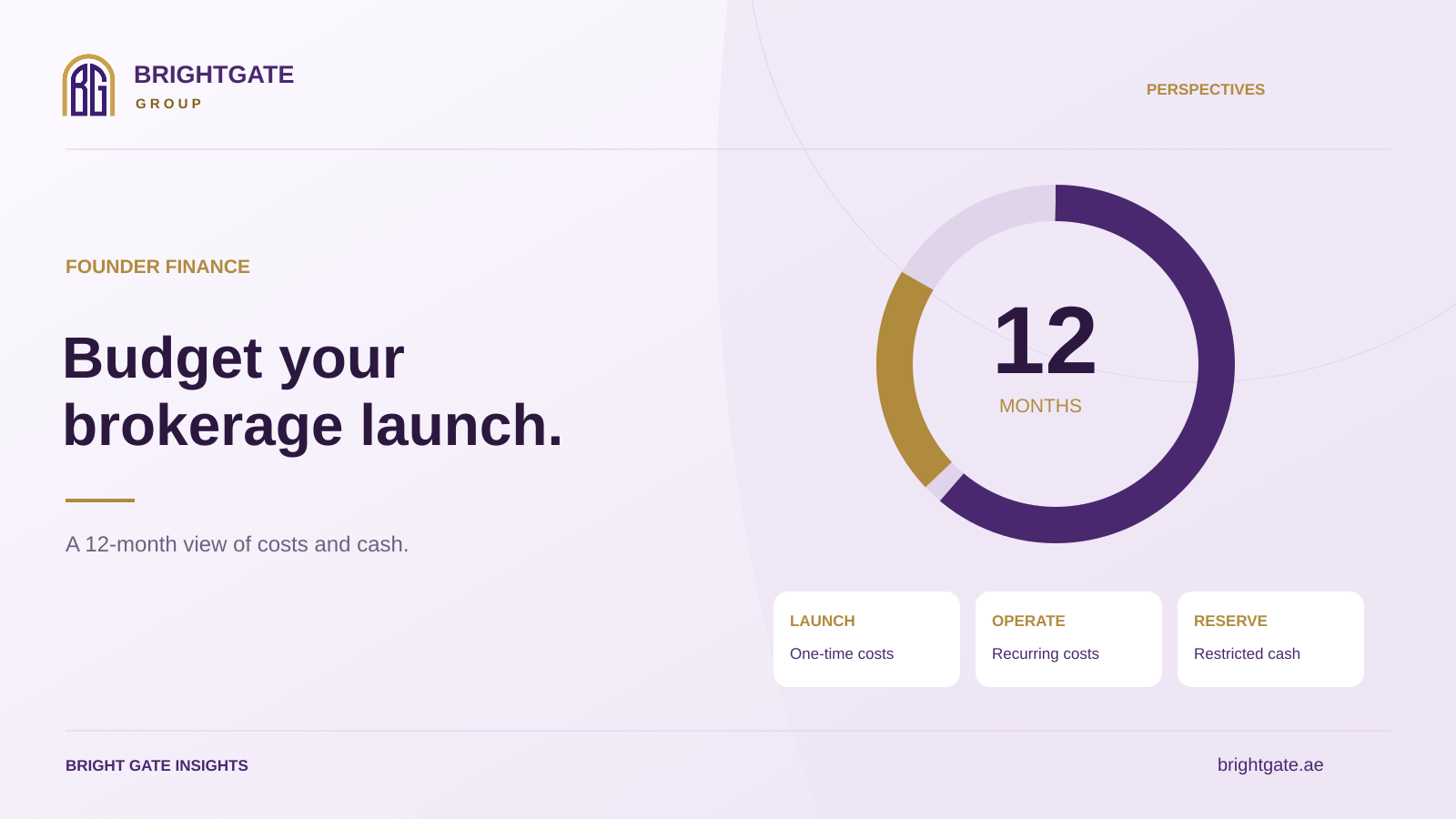
A forex brokerage budget should answer two questions: what will the business spend, and how much cash must remain available before revenue is dependable? A platform quotation answers neither on its own. For UAE-based founders, the useful starting point is a month-by-month plan tied to the proposed legal entity, permitted activities and target markets.
This guide provides a planning framework, not a market-price estimate, regulatory capital calculation or Bright Gate quotation. Obtain written provider proposals and jurisdiction-specific professional advice before committing funds.
Define the operating model before comparing costs
Write a one-page scope: intended clients and countries, products, execution model, expected account numbers, transaction volumes, support hours and outsourcing arrangements. A white-label launch, an independently operated brokerage and an acquisition have different cost structures. Compare those routes in our brokerage model guide before requesting like-for-like proposals.
Being based in Dubai does not, by itself, identify which financial-services permissions a business needs. Incorporation and a trading-platform agreement are not substitutes for regulatory authorisation. Map the proposed activities and customer locations with qualified advisers; our licensing overview explains the questions to resolve.
Separate four funding buckets
1. One-off launch expenditure
Include formation and application work, legal documentation, implementation, integrations, branding, data migration where relevant, security review and acceptance testing. Record payment milestones, taxes where applicable and what happens if approval or onboarding is delayed. Do not treat a supplier’s setup charge as the total launch cost.
2. Recurring operating expenditure
Build monthly lines for platform and infrastructure subscriptions, CRM, hosting, monitoring, compliance operations, staffing, professional services, office requirements, insurance where needed and customer support. Allocate annual renewals to their actual payment months, not just an averaged monthly figure. List whether each service starts billing at signature, installation or go-live.
3. Usage-based and commercial costs
Model payment processing, identity checks, market data, connectivity, liquidity-related charges and other volume-dependent services according to the actual contract. Separate minimum commitments from incremental usage. Ask whether a minimum is credited against usage or charged in addition, and whether discounts depend on volumes the business has not yet achieved.
4. Capital, collateral and reserves
Track regulatory capital, provider deposits, collateral and payment reserves separately from ordinary expenses. These amounts can constrain available cash even when they are not costs in the accounting sense. Record restrictions, release conditions, currency and timing. Ask the relevant advisers how regulatory capital and operating losses interact; do not assume one deposit satisfies every requirement. Client money is not operating runway.
Build a quote-comparison worksheet
Use one row per deliverable and require the following fields from each supplier:
- Scope and owner: exact service, contracting entity and responsibility for integration and ongoing support.
- Commercial terms: one-off fee, recurring minimum, usage unit, currency, taxes and payment dates.
- Dependencies: approvals, bank or payment onboarding, testing and third-party services required before launch.
- Included versus excluded: hosting, backup, upgrades, reporting, data access and incident support.
- Exit terms: notice period, renewal mechanism, termination charges and data export or migration assistance.
- Evidence: dated written quote, expiry date, assumptions and unresolved questions.
Mark bundled items explicitly so they are not counted twice. Equally, do not assume an integration exists simply because two suppliers advertise compatible products. MetaQuotes describes MetaTrader 5 gateways and APIs; the founder still needs to establish which connections, implementation work and support are included in the specific proposal.
Model the cash timeline, not only the annual total
Create columns for pre-launch months and the first 12 operating months. Start with unrestricted company cash. Add committed funding when it is genuinely available, then subtract cash expenses and transfers into restricted deposits or reserves. Show releases only when the contract and assumptions support them. Keep a separate regulatory-capital schedule rather than treating this cash worksheet as a compliance calculation.
Run a base case and a delayed-launch case. If staff and subscriptions begin before onboarding is complete, a later launch can consume runway without generating the expected revenue. Stress-test lower trading activity, slower payment settlement, reserve increases, currency movements and an essential supplier replacement. Do not assume forecast revenue arrives on the same day it is recognised.
Illustrative arithmetic only: suppose a hypothetical project has USD 40,000 of one-off expenditure, USD 15,000 of monthly cash operating costs for 12 months, USD 30,000 of restricted deposits and a USD 25,000 contingency. Its gross funding envelope is USD 275,000 before revenue, additional variable costs and any separate regulatory-capital requirement. These invented figures demonstrate the structure; they are not typical brokerage costs or a quotation. Avoid adding overlapping capital or collateral amounts twice.
Check UAE-related assumptions against the right sources
Use the relevant regulator’s current requirements, not a generic online licence price. For example, the DFSA fees page says application fees vary by financial service and directs applicants to its Fees module. That is a DIFC-specific reference, not a fee schedule for every UAE or overseas brokerage structure. An application fee is also not the total cost of obtaining and maintaining permission.
For payment assumptions, work through our PSP selection checklist. For technical dependencies and test costs, use the liquidity integration checklist. Replace every placeholder with a dated quote or a clearly owned assumption before approving the budget.
The decision to make before signing
A launch budget is ready for a decision when its material exclusions are visible, funding is available on the required dates, and the business can withstand the agreed downside scenario. The cheapest initial package is not necessarily the lowest-cost operating model.
Bright Gate provides setup advisory and coordination support; it does not grant regulatory approvals or guarantee banking, supplier acceptance, launch dates or commercial results. Contact Bright Gate to discuss your proposed scope and the inputs needed for a tailored planning exercise.