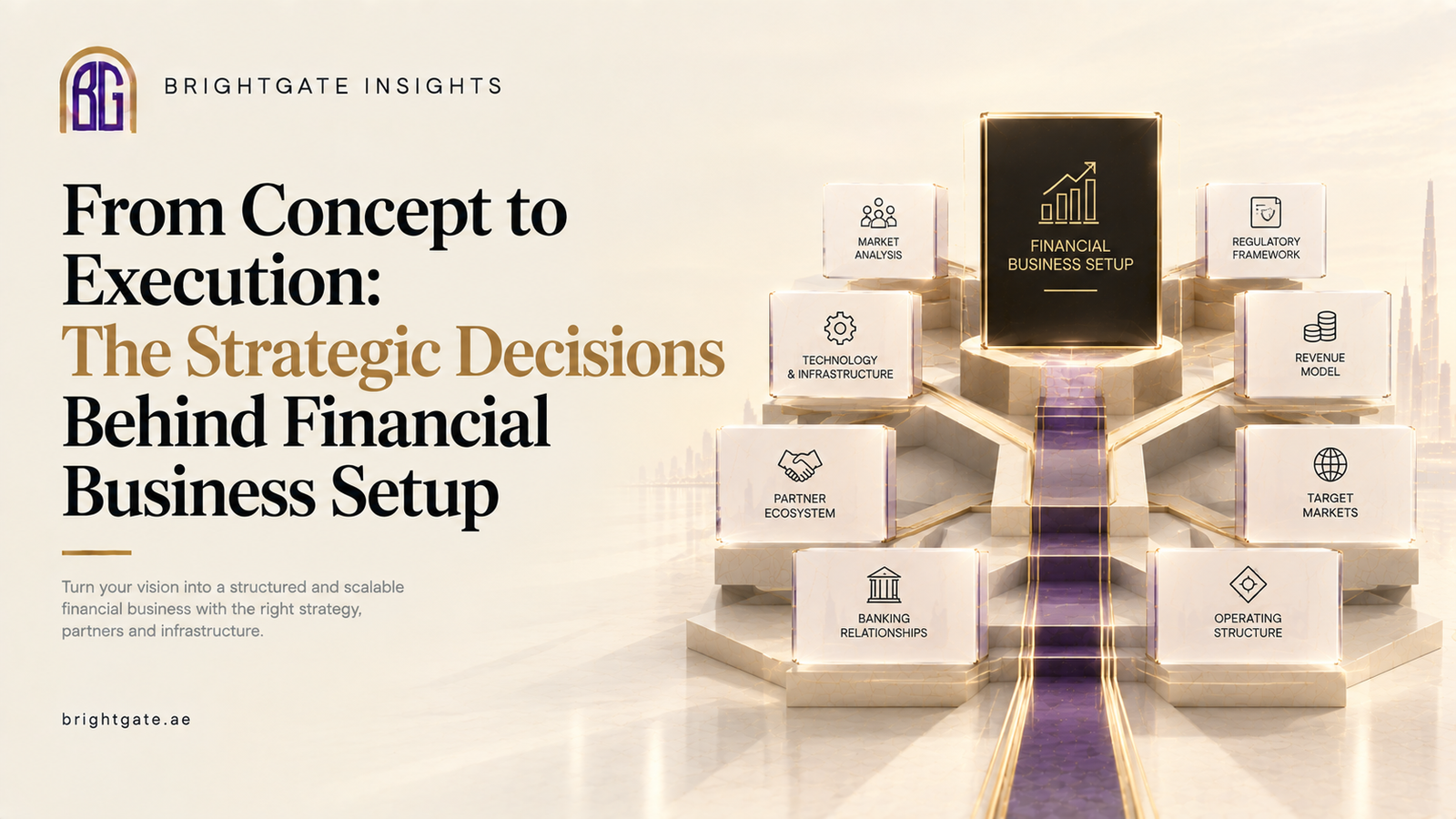
The process of a financial business setup starts with a customer need, which is implemented based on decisions made prior to launch. Founders need to establish the service, target users, revenue model, operating costs and markets to which they will cater. Another determinant of the activities that the company will undertake in-house and those that will be outsourced is a good plan.
Bright Gate Group consults companies on the assessment of structures and the organization of appropriate options by means of independent providers. The aim is to create a working model that can be tested, measured and changed when new information comes in. It must establish priorities of launch, establish measurable results and how the company will react to the change of assumptions.
1. Choose the First Market Carefully
A market can appear attractive since it has a large number of potential customers, but the demand does not mean that it is viable to venture into the market. Research customer behavior, competition, mode of payment, average transaction value and cost of accessing customers.
Consider the requirement of the customers to get local support, local currency payment or to get some banking services.
2. Select a Suitable Legal and Operating Structure
The structure of the company affects the ownership, contracts, taxes, reporting and decision-making. Depending on the activity to be undertaken, the customers to be targeted, the place where the management will be, and the local regulations, the right one will be identified. The right to carry out all the financial operations is not always provided by the incorporation of a company.
The founders are advised to consult experienced legal and tax professionals before making a decision on a jurisdiction. It is also their duty to verify requirements with the concerned authorities. Write a decision record, explaining why the chosen structure is suitable to the business model, and any circumstances in which the business cannot start.
3. Map the Compliance Requirements Early
Financial requirements of different services and jurisdictions are different. The requirements of a software developer, investment company, lender and a payment company may vary. The first thing is to explain the product in a way that shows how it moves money, who has control over the customer’s money and what the company does.
Depending on the activity, work may include checking the customer by doing Know Your Customer (KYC) checks, setting up Anti-Money Laundering (AML) controls, screening for sanctions, protecting data and keeping records.
Hire services of trained people to understand which rules to follow. Build compliance into the product from the start, rather than adding it after development. For example, onboarding screens should collect the needed information in a way and monitoring systems should create logs that can be seen by the right people.
4. Build a Realistic Financial Plan
The first expenses are the cost of setting up the company, hiring consultancy services, buying technology, doing security testing making integrations and researching customers. Recurring costs include staff, cloud hosting, payment processing, support, audits and compliance operations.
Projected revenue should not be treated as cash. Working‑capital gaps can arise from delays in settlement refunds, chargebacks and outstanding invoices. Set limits of approval and compare actual performance with forecast each month.
Plan Dependencies Before Setting a Launch Date
Founders should create a dependency map before setting a launch date. This map should list all activities that need to be done. Each activity should be clearly defined, whether it needs to be registered in the company, onboarded by a provider, integrated, tested for security or reviewed by a professional. For every task, there must be an owner and a target date. Any potential delays or blockers should be noted upfront.
At launch reviews the team can compare what was planned versus what actually happened. These meetings should not turn into status reports. The focus should stay on progress and ownership. The founder must retain ownership of the launch process.
Also keep a decision journal. This journal needs to record the decisions that were made the, choices that were looked at and the reasons why those choices were not picked. This record helps new team members see how things got set up. It also provides leaders with a base to look back at decisions if costs go up customer needs change or market situations change.
5. Design Technology for Reliability and Change
The technology should not be too complicated to work with the business model. Onboarding, account records, payments, reporting and risk checks can be split into sections. These sections are linked using application programming interfaces (APIs). Having documented endpoints and version control helps stop integration mistakes.
Data that is moving and data that is stored should be encrypted. Multi-factor authentication has to be used. Role-based access controls are necessary. Audit logs need to be kept. Verified backups are important. Security audits and testing have to happen before dealing with customer data.
Incident response plans have to be written down. This includes who is allowed to stop access, who tells the people affected how evidence is kept and who allows recovery.
6. Evaluate Banking and Payment Connections
Banking and payment arrangements set how the company gets money, pays, serves customers and balances transactions. The potential providers will be considered for coverage of Banking and payment arrangements services, onboarding policies, supported currencies, charges, settlement time, technical compatibility and support. Monitor Banking and payment arrangements success rate, settlement time reconciliation exceptions, chargebacks and cost per completed transaction.
Banking and payment arrangements responsibilities, escalation routes, reporting and escape routes will be explained in contracts. When the critical provider is not easily replaceable, have a plan and understand the cost involved to change. Bright Gate Group can provide advisory services to assess and organize financial business setup through providers.
Turn Decisions Into a Workable Launch Plan
Only a structured funded technologically compliant and relationship‑based idea with its providers can make a business. Early testing of assumptions by founders lets them see points before they become costly problems.
Contact Bright Gate Group for advisory services to help think about business structures and to arrange suitable independent infrastructure providers. A healthy business structure gives a decision maker for every decision, a response to every risk and a growth meter for every stage.