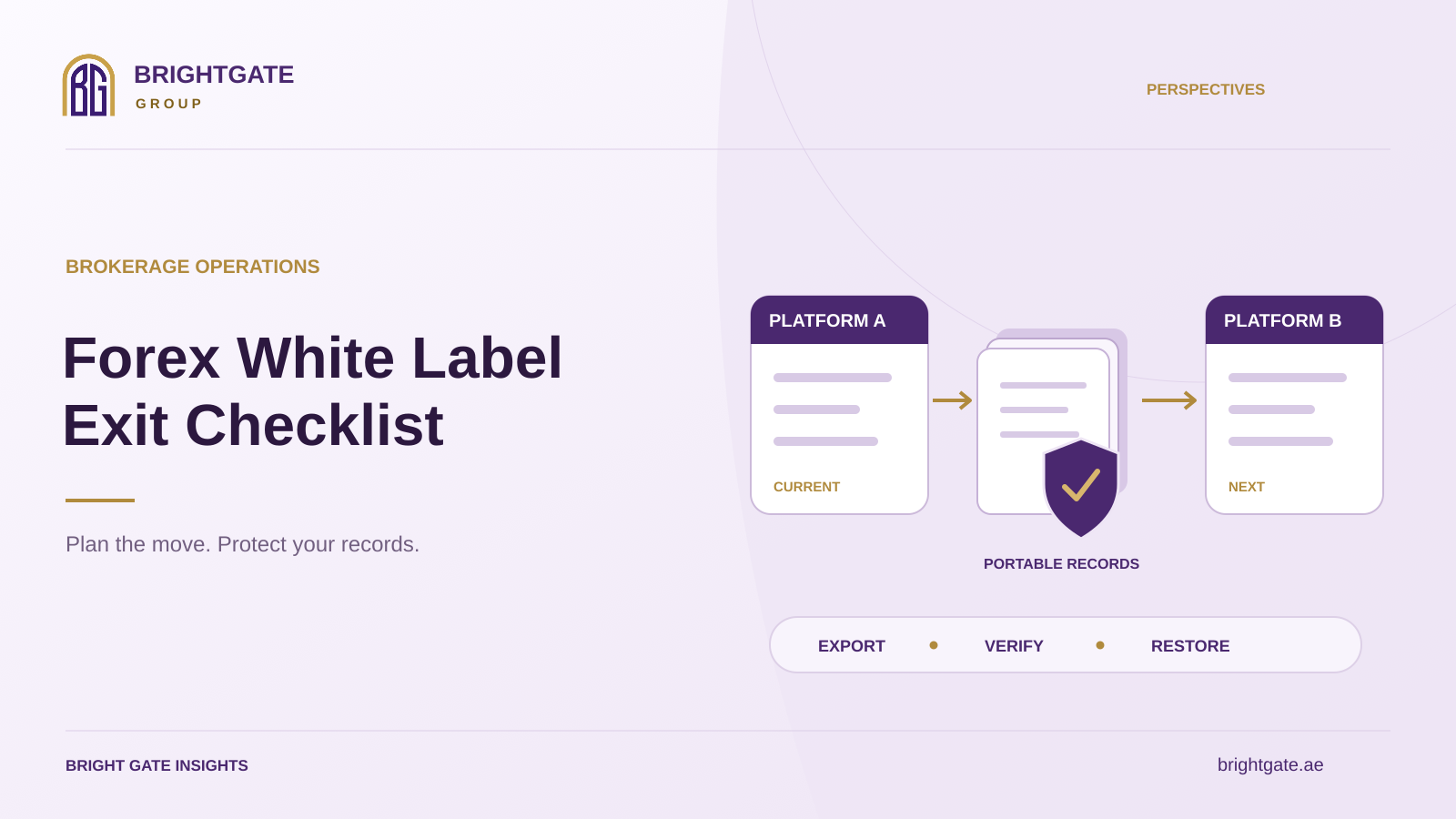
A white label proposal tells you how quickly a brokerage can launch. It rarely tells you what you could take with you if a provider changes terms, discontinues a product or no longer fits the business. For founders comparing arrangements in the UAE, the useful test is to ask for an exit rehearsal before signing, while you still have leverage to define the handover.
The pass condition: Your team can identify what it controls, inspect a representative export and show that it can read and reconcile the records outside the provider’s live system. A file labelled “backup” is not evidence that another system can use it.
1. Map control before you compare quotes
Start with the legal entity contracting with clients, the entities that administer the platform, CRM and payments, and the people who can approve changes. Record where each dependency lives and who can release it. Separate contractual rights from everyday admin access: a dashboard login does not guarantee the right to a usable export after termination.
- Client and compliance records: Establish which party holds customer profiles, onboarding decisions, supporting evidence and audit trails. Have legal and compliance review what can be transferred, retained or accessed, and by whom.
- Trading and cash records: Map accounts, activity, positions, pending orders, balances, adjustments, withdrawals and statement history to their authoritative systems. Identify who can export each dataset.
- Business dependencies: List the domain, communications channels, payment agreements, liquidity and bridge connections, integrations, and introducing-broker records. Record whether each dependency can be retained, reassigned with consent or must be replaced.
2. Make the provider show a usable sample before signing
Request a synthetic sample, a field dictionary and a list of excluded records. Ask which fields link the CRM, trading and payments datasets, how timestamps and currencies are represented, and whether attachments and historical changes come separately. An example export should include trickier states such as a pending withdrawal, a partial fill or a revised identity check, not only clean accounts.
Give the sample to someone who has not used the original dashboard. Ask them to construct an account record, match its trading ID to the CRM and reconcile a balance against the cash ledger in the correct currency. The test fails if the numbers match only after undocumented manual adjustments, or if someone needs to log into the old system to understand what a field means. Use synthetic data for a demonstration; agree the legal basis, approved destination and secure transfer process before using any real client data. See the UAE government’s data-protection overview as a starting point, and have counsel establish the applicable regime.
3. Put the exit deliverables in the agreement
Specify the export formats and coverage, frequency of routine backups, deadline for a final export and the support available during the transition. Put pricing around one-off exports, continued read-only access and any overlap between providers. Write down when the notice clock starts, what happens if a provider is unresponsive, and who is responsible for confirming that data has been returned or disposed of when allowed. Ask counsel to review the terms. The aim is to turn a sales promise into deliverables that both sides can verify.
4. Rehearse the cutover and define when to stop
Assign named owners for trading, payments, records and client communication. Agree a snapshot time, log changes after that snapshot and reconcile separately by currency and account group. Compare record counts, account-level balances and a sample of statements. For an MT5 arrangement, ask the relevant provider to confirm each supported migration path in writing, including what cannot be transferred. Do not assume that open positions, orders or platform logins can move unchanged. Decide with the relevant providers and advisers how each exception will be handled before setting a changeover date.
Make the go/no-go rule concrete: do not switch if any balance difference is unexplained, transaction and position treatment is unconfirmed, or the team cannot serve clients on the fallback plan. If the new system has already accepted transactions, restoring an old snapshot alone could drop those events. Agree how they will be captured, reconciled and replayed or otherwise accounted for before calling rollback viable.
What to ask on the first vendor call
- Can you show a representative export and a field dictionary this week?
- Which data, accounts and agreements would not move, and who has to consent?
- What does it cost to maintain overlap and retrieve earlier statements?
- Who signs off on reconciliation, and what happens if the rehearsal fails?
For the cost of parallel subscriptions and transition support, use the 12-month brokerage budget guide. If you are still choosing a launch route, use Bright Gate’s forex brokerage comparison and white label advisory overview. Dependencies on the execution stack can be reviewed with our liquidity integration checklist. Bright Gate provides advisory and coordinates with independent specialists. This article is an operational planning resource, not legal advice or a guarantee that a provider will support a migration.