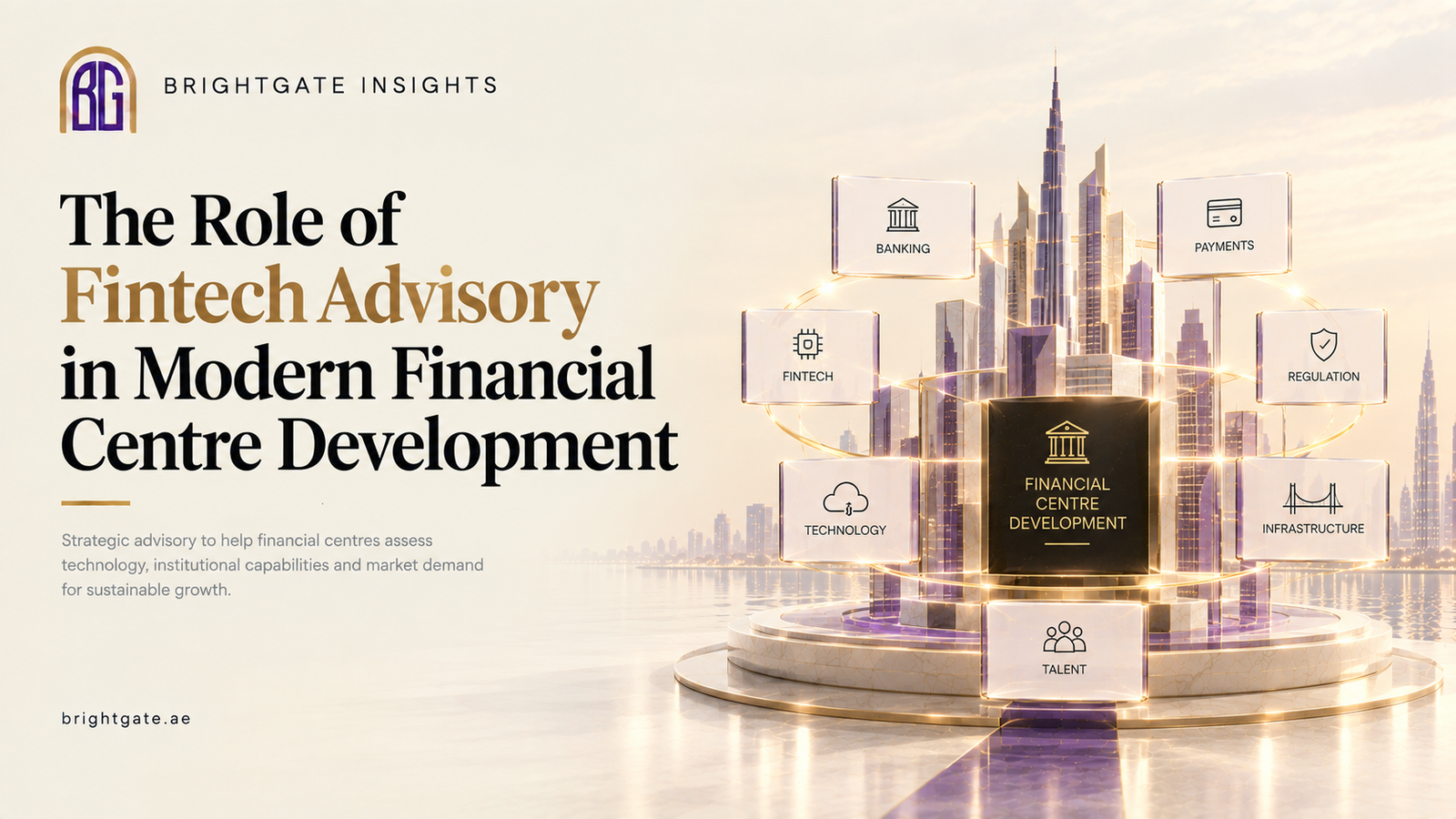
A financial centre needs more than institutions and modern office buildings to compete internationally. It needs reliable payment systems, secure data exchange, connected financial services and institutions capable of operating that infrastructure.
Fintech advisory helps jurisdictions assess how digital finance can support their target sectors, institutional capabilities and economic objectives. The starting point is understanding which market needs the financial centre intends to serve and what capabilities are required.
Bright Gate Group advises on financial centre development by assessing competitive positioning, financial-services requirements, institutional readiness and implementation priorities. These assessments help stakeholders develop a coordinated roadmap.
Why Financial Centres Need a Clear Fintech Strategy
Financial technology shapes how businesses accept payments, exchange data, onboard customers and monitor transactions. API connectivity, digital payment systems and regulatory technology can support these activities, provided they fit the institutions and markets using them.
Introducing a platform without the necessary skills, connectivity, governance or operating procedures can create new dependencies rather than solve existing problems.
Fintech advisory helps decision-makers assess demand before committing to specific solutions. This includes identifying target users, reviewing institutional readiness, mapping existing infrastructure and examining barriers to adoption. The assessment should distinguish essential capabilities from features that can be introduced later.
Building Digital Infrastructure Around Market Needs
Digital infrastructure should support the financial activities a jurisdiction intends to attract. A centre targeting payment and fintech businesses may prioritise payment connectivity, digital onboarding and secure data exchange. A centre focused on institutional markets may place greater emphasis on transaction processing, market data, reporting and settlement arrangements.
Technical assessment should cover interoperability, cybersecurity, operational resilience, dependence on third-party providers and scalability. Decision-makers should also establish who will operate each component, how it will be funded and who will maintain it after launch.
Bright Gate Group’s advisory framework considers infrastructure requirements alongside the jurisdiction’s market objectives and institutional capabilities. This helps connect technology evaluation with a realistic development plan.
Connecting Fintech Innovation With Financial Services
A financial centre should identify opportunities that reflect its economic strengths, institutional capabilities and market demand. Potential areas include digital payments, embedded finance, digital banking, wealth technology and financial data services. Each requires a separate assessment of commercial demand, regulatory requirements and implementation feasibility.
Embedded finance can allow non-financial businesses to integrate financial services through appropriate financial-service providers. APIs can connect systems and support controlled data exchange, while digital onboarding can reduce manual processing when identity verification and supporting workflows are properly designed.
Before selecting a solution, stakeholders should define the target users, operating model, provider responsibilities and integration requirements. Bright Gate Group assesses these opportunities within the wider financial centre strategy and coordinates specialist input where required.
Managing Security, Data, and Operational Risk
Digital financial services depend on secure information handling and reliable operations. Security and resilience requirements should be defined before providers and system architectures are selected.
Specialist assessments may cover identity and access management, encryption, API authentication, audit logs, data permissions, incident response and business continuity. Where institutions exchange information, responsibilities for data access, incident escalation and recovery should be clearly documented.
Recovery time objectives define the target time for restoring a service after disruption. Recovery point objectives define the point to which data must be recoverable, informing the maximum acceptable data loss. These objectives should reflect business impact, system dependencies and applicable requirements, and should be tested.
Bright Gate Group helps stakeholders identify the questions and dependencies requiring assessment by qualified technology, cybersecurity and compliance specialists.
Positioning a Financial Centre for International Participation
Financial centres compete for institutions, fintech businesses, investment and specialist talent. Technology contributes to their appeal, but prospective participants also assess regulatory clarity, professional services, banking connectivity, operating costs, talent availability and the predictability of the business environment.
The development strategy should identify sectors in which the jurisdiction has a credible advantage. For example, established international trade links may justify assessing cross-border payment opportunities, while an existing financial-services sector may provide demand for digital onboarding or reporting infrastructure. These are opportunities to test against evidence, rather than assumptions on which to commit resources.
Bright Gate Group’s Financial Centre Development Advisory framework considers competitive positioning, sector opportunities, institutional capability, and long-term development planning. The purpose is to help stakeholders define priorities that reflect the jurisdiction’s genuine strengths.
Turning Advisory Into a Phased Development Roadmap
Financial centre development involves connected workstreams that cannot always progress at the same pace. A phased roadmap helps stakeholders sequence investment around market demand, institutional readiness, available resources and implementation dependencies.
A practical roadmap can include:
- Assess: Map existing infrastructure, institutional capabilities, target sectors and market gaps.
- Prioritise: Identify the use cases with credible demand and define the capabilities required.
- Validate: Assess feasibility, specialist requirements, provider options and operating costs.
- Implement: Assign responsibilities, coordinate integrations and test operational readiness.
- Review: Measure adoption, service performance and progress against agreed objectives.
Useful measures may include active institutional participation, adoption by target users, transaction-processing performance, system availability, implementation milestones and operating costs. Measures should have a baseline, a defined owner and a review schedule.
Bright Gate Group advises on development priorities and coordinates relevant independent specialists where required. Regulatory and licensing decisions remain with the competent authorities. Banking and payment services remain subject to the relevant independent providers’ eligibility requirements, due diligence and approval.
Build a Financial Centre Strategy Around Real Capabilities
A competitive financial centre needs technology that serves a defined market, institutions prepared to use it and clear responsibilities for operating it. Development planning should connect these requirements before major infrastructure commitments are made.
Bright Gate Group helps jurisdictions assess market opportunities, institutional capabilities and implementation priorities through its Financial Centre Development Advisory service. Explore the advisory framework or contact the team to discuss your jurisdiction’s objectives and the next steps towards a phased development roadmap.
Related Reading: Financial Ecosystem Development: Bright Gate’s Advisory Approach